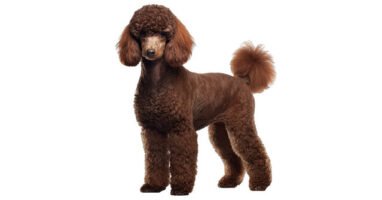
The Standard is where the breed started: a big, athletic water dog that happens to wear a famous haircut. Forget the show ring stereotype. A well bred Standard is closer to a training partner than an ornament, and it will happily reorganize your schedule around that fact.
Standards are also the most demanding poodle to own, in exercise, in grooming, and in sheer presence. This guide covers the size, the temperament, the bloat risk every owner needs to understand, and what daily life with one actually requires.
The Original Working Poodle
The breed was developed in Germany as a duck retriever, and the name traces to the German word Pudel, describing a dog splashing in water. Everything about the original dog was functional, including the clip: legs and hindquarters clipped close to reduce drag, puffs of coat left over the joints and chest as protection against cold water.
France refined the image and made the breed fashionable, but the working engine never left. Modern Standards still retrieve, still take to swimming like it is their job, and still light up when given real work to do.
Standard Poodle Size and Build
Standards stand over 15 inches at the shoulder, with most adults landing somewhere between 20 and 24 inches. Males typically weigh 60 to 70 pounds and females 40 to 50, and it is lean, leggy athlete rather than bulk.
They grow fast through the first year and fill out slowly afterward, so the gangly teenage phase lasts a while. The poodle growth and weight chart shows the expected curve from puppyhood to the full adult frame.
Set against the smaller varieties in our Toy, Miniature, and Standard comparison, the Standard is the only one that changes your logistics: car space, food quantities, grooming bills, and the strength needed at the other end of the leash.
Temperament: Proud, Bright, and All In
Standards are famously intelligent, and living with one feels like it. They learn words, routines, and loopholes with equal speed, and they keep a playful, mischievous streak well into adulthood.
They are people dogs through and through. A Standard expects to be a full member of the household, follows the action from room to room, and does poorly when relegated to the yard. Most are watchful and will announce visitors, without tipping over into aggression.
Sensitivity comes with the package. Standards read their people closely and wilt under harsh handling, so training built on rewards and clarity gets far more out of them than force ever will.
Family Life and Children
With their size and patience, Standards are often excellent family dogs. They play hard outside, settle reasonably indoors once exercised, and tend to be gentle with children they know.
Supervision with very young children is still the rule, mostly because a boisterous 60 pound adolescent can knock a toddler over without a trace of malice. Introductions to other pets are usually smooth, especially when the dog was socialized early.
Socialization deserves emphasis at this size. A well exposed Standard grows up confident and easygoing. An under socialized one can become reserved and anxious in new situations, and anxiety in a dog this big is a much larger management problem.
Exercise: Budget 60 to 90 Minutes
This is the commitment that decides whether a Standard thrives or redecorates your home. Adults need 60 to 90 minutes of real activity a day: brisk walks, running, fetch, hiking, or swimming, which most take to readily because the breed was built in the water.
Our guide to poodle exercise needs breaks the amounts down by size and age. Puppies need the volume dialed right down while their growth plates are still open, with short sessions and no forced long runs.
Mental work is not an optional extra. Training, scent games, puzzle feeders, and dog sports such as agility or obedience burn energy that a walk cannot reach.
A Standard with a tired brain and a tired body is a calm housemate. Miss either half and you will hear about it.
Space: What a Big Poodle Needs at Home
A Standard does not strictly require a house with a yard, but it does require a household organized around activity. Apartment living can work for a committed owner who delivers the exercise, though stairs, elevators, and a wet 60 pound dog in a small hallway are genuine logistics.
Inside the home, expect a dog that takes up real space: a large crate, a bed the size of a small sofa, and a corner for the grooming kit you will definitely accumulate. A fenced yard helps enormously for toilet breaks and games, but it never replaces walks and training.
Grooming the Biggest Coat in the Breed
Everything said about Toy and Miniature grooming applies here, scaled up. The dense curly coat needs brushing several times a week at minimum, worked down to the skin in sections, or mats will form in the friction zones: the armpits, behind the ears, and wherever the collar sits.
Professional grooming every 4 to 6 weeks is the norm, and a Standard costs more to groom than the smaller sizes simply because there is more dog. Depending on coat length and your area, $80 to $120 per session is a realistic planning range. The ASPCA’s grooming tips cover home technique, and most owners keep a practical short clip rather than anything sculpted.
Add ear cleaning to the routine, since heavy, hairy ear flaps trap moisture, plus regular nail trims and tooth brushing. None of it is complicated. All of it is permanent.
Feeding and the Weight Conversation
Feed a quality large breed food with real meat first on the label, in measured meals twice a day rather than free choice grazing. Standards are food motivated and gain steadily when portions drift, and extra weight punishes hips and elbows over time.
You should be able to feel ribs easily under a light covering of fat, and see a waist from above and from the side. Your vet can confirm body condition at checkups, and the AVMA’s pet care pages are a dependable reference for preventive basics. Puppies stay on large breed puppy food until roughly 12 to 18 months, on your vet’s advice.
Health: Know the Bloat Signs Cold
Standards commonly live 12 to 15 years. The breed’s predispositions include hip dysplasia, progressive retinal atrophy, Addison’s disease, and sebaceous adenitis, a skin condition that affects the coat.
Addison’s disease is a particular Standard risk, and our guide to Addison’s disease in poodles.
Responsible breeders screen for what can be screened, and you should ask to see the results. Our rundown of poodle health problems by size shows how the Standard’s list differs from the smaller varieties.
One condition deserves its own paragraph. Bloat, properly called gastric dilatation volvulus, is a life threatening emergency that deep chested breeds like the Standard are predisposed to. The stomach fills with gas and can twist on itself, and a dog can deteriorate within hours.
Unproductive retching, a swollen or tight abdomen, drooling, and restlessness mean an emergency vet visit immediately, not in the morning. Knowing those signs in advance is the single most valuable health fact a Standard owner can carry.
For that later stage of life, see our senior poodle care guide.
Training a Standard Poodle
Training is where Standards repay you. The basics come quickly, and the breed goes on happily to advanced obedience, rally, agility, tracking, and even therapy work. Start the day a puppy comes home: name recognition, recall games, leash manners, and a consistent house training schedule.
Keep methods reward based and varied. Repetitive drilling bores a Standard into inventing variations of its own, which is charming in theory and chaos in practice. The AKC’s training resources are a good starting library.
One caution: a big, strong, undertrained adolescent is a genuine handful. Puppy classes and early consistency are not luxuries with a dog that will soon outweigh many ten year olds.
Common Mistakes With Standards
The classic error is choosing the breed for the look and discovering the athlete afterward. Owners who expected a calm, elegant house dog and skip the exercise end up with a barking, bouncing, counter surfing project instead.
Letting the coat go is the second. A few skipped weeks of brushing on a Standard means mats tight against the skin, and the fix is usually a full shave down. The third is table scraps and free poured kibble, followed by surprise when the vet keeps mentioning weight.
Is a Standard Poodle Right for You?
Say yes if you are active, home a fair amount, and genuinely enjoy training and grooming routines. In return you get an intelligent, funny, deeply loyal dog that can join in almost anything you do.
Say no, honestly, if your days are long and spent away from home, or if the grooming budget makes you wince. A Miniature gives you most of the same character in a smaller and cheaper package. There is no wrong answer here, just a wrong match.
Frequently Asked Questions
How much exercise does a Standard Poodle need?
Adults need 60 to 90 minutes of genuine activity a day, split across walks, play, and training. Puppies and seniors need less, in shorter and gentler sessions, and mental work matters at every age.
Are Standard Poodles good family dogs?
Generally yes. They are patient, playful, and bond closely with the whole household. Supervise them around very young children, as you would with any large and boisterous young dog.
Do Standard Poodles shed?
Very little. Loose hair gets trapped in the dense curls instead of falling around the house, which is precisely why regular brushing matters so much. No dog is completely allergen free, but Standards are among the lowest shedding breeds.
How long do Standard Poodles live?
Typically 12 to 15 years with good care. Healthy weight, real exercise, dental care, and regular vet checkups are the habits that carry a Standard toward the top of that range.
Are Standard Poodles high maintenance?
Yes, mainly because of the coat and the exercise requirement. Expect brushing several times a week, professional grooming every 4 to 6 weeks, and over an hour of activity daily. Owners who enjoy that routine find it rewarding rather than burdensome.



16 Comments on “Standard Poodle: Size, Temperament, Care & Traits”