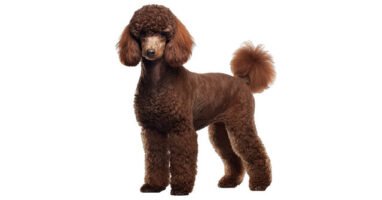
Toy, Miniature, or Standard is the first real decision in Poodle ownership, and it is not really a decision about cuteness. The size you pick decides how much exercise you owe every day, what grooming costs, how fragile your dog is around small children, and how the dog fits your car, your flat, and your life for the next 15 years or so.
All three sizes are the same breed with the same brain and the same coat. What changes is the body wrapped around them, and the knock-on effects of that body are bigger than most first-time buyers expect.
One Breed, Three Sizes
The Standard is the original dog, developed as a water retriever, and the smaller sizes were bred down from it over centuries. The Miniature found work in truffle woods and circuses, and the Toy was bred purely for companionship. Our Poodle history covers how each size earned its place.
Because they share one breed standard and one gene pool, temperament overlaps a lot across sizes. The differences below are tendencies and practical realities, not separate personalities stamped at the factory.
The Three Sizes at a Glance
| Toy | Miniature | Standard | |
|---|---|---|---|
| Height at shoulder | Up to 10 inches | 10 to 15 inches | Over 15 inches, most 18 to 24 |
| Typical weight | 4 to 6 pounds | 10 to 15 pounds | 40 to 70 pounds |
| Daily exercise | 30 to 45 minutes | 45 to 60 minutes | 60 to 90 minutes |
| Grooming load | Lowest total coat, same routine | Moderate | Highest, longest sessions and bills |
| Typical lifespan | 14 to 18 years | 14 to 17 years | 12 to 15 years |
| Best for | Apartments, travel, calm households | Versatile families, first Poodles | Active homes, dog sports, bigger kids |
One unofficial fourth option deserves a mention. The Moyen Poodle, the European medium size, lands between Miniature and Standard at roughly 15 to 20 inches. North American registries class it as a small Standard, but many buyers deliberately shop for that in-between size.
Size in Real Life, Not on Paper
A Toy’s size is a lifestyle feature and a safety issue at the same time. Toys travel in cabins, fit in small flats, and can be carried out of trouble. They can also be hurt by a dropped object, a missed step on the stairs, or an enthusiastic toddler, and their bones genuinely are fragile.
The Miniature is the sturdiest small option. Ten to fifteen pounds is still a portable dog, light enough to lift and easy to control on the lead, but solid enough for proper walks, rougher play, and most family chaos.
A Standard is a large dog by any honest definition. Males of 60 to 70 pounds take up real space, need a car that fits them, and can clear a coffee table with one happy tail sweep. In return you get the most physically capable dog of the three, and the one least likely to be injured by everyday accidents.
Temperament: Shared Core, Different Volume
Every size is intelligent, trainable, people-focused, and prone to boredom. Where owners notice differences is in intensity. Standards tend to read as the calmest and steadiest of the three once mature, with a quiet, observant manner that surprises people expecting a fussy dog.
Miniatures are frequently the liveliest. They are alert, curious, and quick to announce visitors, which makes them engaging companions and enthusiastic watchdogs.
Toys often bond the hardest to one person and shadow them everywhere. That devotion is charming, but it needs boundaries and training from the start.
An untrained Toy is where the yappy, bossy small-dog stereotype comes from. The dog is rarely the problem. The skipped training is.
Exercise: Minutes Are Only Half the Story
Standards need the most, around 60 to 90 minutes a day including something more interesting than a slow amble. Swimming, fetch, hiking, and dog sports suit them well, and an under-exercised Standard tends to redecorate.
Miniatures do well on 45 to 60 minutes. They are athletic for their size and usually up for more than owners expect, so do not assume the smaller dog wants the shorter walk.
Toys need the least physically, roughly 30 to 45 minutes split across the day, and indoor play genuinely counts for them in bad weather. What no size can skip is mental work. Training games, sniffing games, and puzzle feeders tire a Poodle brain in a way a walk alone does not, at every size.
Grooming: Same Coat, Different Bill
The coat does not change with size: dense, curly, low-shedding, and quick to mat. Every Poodle needs brushing several times a week and a clip every four to six weeks, and none of them is a wash-and-go dog. The ASPCA’s dog grooming guidance makes the same point about consistency for coated breeds.
What changes is volume and cost. A Standard has several times the coat area of a Toy, so home sessions run longer and professional grooms cost noticeably more. Toys are the quickest and cheapest to maintain but mat just as fast, so the brushing schedule stays the same even though each session is short.
Also be accurate about allergies while you are comparing. Poodles shed very little, which helps many sensitive households, but no dog is truly hypoallergenic at any size.
Time is part of the bill too. Bathing, drying, and clipping a Standard at home can eat up two to three hours, while a Toy in a short clip is done in under one. If you plan to groom at home, that monthly time difference is worth weighing alongside the groomer’s prices.
Health and Lifespan by Size
Smaller Poodles usually outlive larger ones, which is the normal pattern across dog breeds. Standards commonly reach 12 to 15 years, while Miniatures and Toys often reach their mid to late teens. Our Poodle lifespan guide breaks down what affects those numbers.
Each size carries its own predispositions. Standards are the size at risk of bloat, a life-threatening stomach emergency, along with hip dysplasia, Addison’s disease, and sebaceous adenitis.
Miniatures and Toys share the small-dog list: slipping kneecaps (patellar luxation), progressive retinal atrophy, and Legg-Calve-Perthes disease. Toys add dental crowding in a tiny jaw, tracheal collapse, and fracture risk.
None of these are guarantees. They are the reasons breeder health testing matters, and the AKC breed pages list the recommended screenings for each size.
Training: Same Lessons, Different Emphasis
Every size learns the same way: short sessions, clear cues, and rewards timed well. What changes is which mistakes cost you most.
With a Standard, manners are a safety issue. A 60-pound dog that lunges at squirrels or jumps on guests is genuinely hard to hold, so lead work and a reliable recall come first, and early obedience classes earn their money.
Miniatures are quick and easily bored. Repetitive drilling switches them off, so variety and short, game-like sessions keep them engaged. Many Minis thrive in agility and trick training precisely because it keeps changing.
With a Toy, the biggest risk is skipping training because the dog is small and easy to scoop up instead. Resist that.
House training also tends to take longer with Toys, partly because of tiny bladders and partly because accidents are easy to miss. Set the same rules you would set for a big dog, and supervise like one too.
One more puppy point applies at every size: young Poodles should not be run, jumped, or exercised to exhaustion while their growth plates are still closing. Standards mature the slowest, often not fully grown until around 18 months, so build distance and intensity gradually and let free play do most of the work in the first year.
Kids, Other Pets, and Daily Chaos
Standards are generally the safest pick with children, simply because they are hard to hurt and tend to stay composed. Supervision still applies, as it does with any dog.
Miniatures suit active families well and handle play without the Toy’s fragility worries. They are the size most often recommended for households with school-age kids.
Toys do best in calmer homes, with older children or adults. It is not a temperament problem. A four-pound dog and a falling preschooler are a bad combination no matter how sweet both of them are.
Costs: The Puppy Price Is the Small Part
Purchase prices overlap a lot across sizes, so look at running costs instead. Standards eat more, need bigger equipment, cost more at the groomer, and often sit in higher vet and boarding weight brackets. Toys cost least to keep day to day but can rack up dental bills if their teeth are neglected.
Over a 15-year life, those monthly differences add up to far more than the gap between puppy prices. Our guide to how much a Poodle costs runs the full numbers if you want them before deciding.
How to Decide: Five Honest Questions
Work through these in order. The right size is the one whose daily needs fit the life you actually live, not the life you plan to start living once the puppy arrives.
- How much exercise will you honestly give on a wet Tuesday in February? Under 45 minutes points to a Toy, around an hour to a Miniature, more than that opens the door to a Standard.
- Who else lives here? Toddlers and boisterous big dogs argue against a Toy. Limited mobility argues against a strong young Standard.
- How much space and car room do you have? Standards fit apartments only with a genuinely committed exercise routine.
- What is your grooming budget, in money or in your own time? Bigger dog, bigger bill, no exceptions.
- How long a commitment are you ready for? A Toy may be with you for 18 years. That is a wonderful thing, and it should be a deliberate one.
The most common mistake is choosing by appearance alone, usually the tiny cute one or the majestic big one. Choose by Tuesday instead. The size that fits your ordinary days is the size that will make you both happy.
Frequently Asked Questions
Which Poodle size is best for a first-time owner?
The Miniature is the usual recommendation. It is sturdy, portable, moderate in exercise and grooming, and forgiving of beginner mistakes. First-time owners who are active and experienced with dogs can also do well with a Standard.
Do Toy Poodles need less training than Standards?
No. They need the same training in the same order, and skipping it because the dog is small is how problem behavior starts. Toys are just as smart and just as capable of learning bad habits.
Which size lives the longest?
Generally the Toy, followed closely by the Miniature. Smaller dogs tend to outlive larger ones, and Toys regularly reach 16 to 18 years with good care.
Can a Standard Poodle live in an apartment?
Yes, but only with an owner who treats exercise as a daily appointment, not a weekend event. Without a garden, you become the garden: long walks, play, and training every day, whatever the weather.
Is there a fourth Poodle size?
In Europe, yes. The FCI recognizes a Medium (Moyen) variety between Miniature and Standard. The AKC and the UK Kennel Club do not list it separately, so those dogs are classed as Standards in North America.




17 Comments on “Toy vs Miniature vs Standard Poodle: Which Is Right for You?”