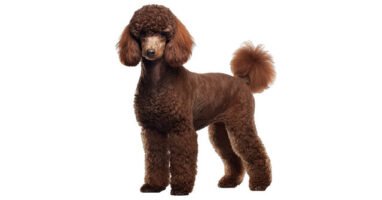
The Poodle’s image problem is that the haircut got famous and the job got forgotten. Underneath the pompons sits one of Europe’s oldest working dogs: a water retriever shaped by German marshes, refined by France, and only later adopted by show rings and circuses.
That history is not trivia. It explains why your Poodle carries socks around the house, adores water, and out-thinks you before breakfast. Here is where the breed actually came from, with the honest caveat that parts of the story are documented fact and parts are tradition repeated so often it has hardened into legend.
A Water Dog From Germany
Start with the name. “Poodle” comes from the German word Pudel, from the verb pudeln, to splash in water. The French name for the breed, Caniche, tells the same story from the other side of the border: it derives from cane, the French for a female duck.
The strongest evidence points to Germany as the breed’s homeland, where Poodle-type dogs worked the lakes and wetlands as retrievers several centuries ago. Dogs that look recognizably Poodle-like, clipped coats and all, appear in European art from the 15th and 16th centuries, often beside hunters.
What is genuinely debated is how much older the roots go. Claims that the breed descends directly from Roman or ancient water dogs are speculation rather than record, and the exact line of descent, including how much the French Barbet contributed, is argued about by breed historians to this day. What nobody disputes is the job: by the time records become solid, Poodles were retrieving shot waterfowl from cold water, and they were very good at it.
Built for Cold Water
Retrieving ducks from a freezing lake is a specific job, and it built a specific dog. The dense, curly coat insulates when wet and sheds water far better than a flat coat would.
Webbed feet give extra push in the swim. A soft mouth carries a bird back without crushing it.
The less visible trait mattered most. A retriever works at a distance, reading wind, water, and a handler’s signals, sometimes making its own decisions about a bird it saw fall and the handler did not. That selects for independent intelligence, not just obedience.
Modern Poodles still carry the whole toolkit. The love of carrying objects, the enthusiasm for swimming, and the brain that needs employment all trace straight back to the marsh.
The Clip Was Workwear
The famous Poodle clip started as engineering, not decoration. A full, wet coat is heavy. It drags on a swimming dog and slows it down, so hunters clipped most of the body short to cut the weight and the resistance.
Shaving everything would have been dangerous in near-freezing water, so the clipping followed a logic. Hair stayed over the chest to protect the heart and lungs, over the hip joints and around the kidneys for warmth, and in tufts at the leg joints, the pompons, to guard them against cold and injury. Hair came off where it only slowed the dog down.
Every puff had a purpose. When the breed later moved into drawing rooms and show rings, groomers kept those shapes and elaborated them into the sculpted patterns we know now. The dog in a continental clip is wearing a stylized version of a working uniform.
France Adopts the Breed
France did not invent the Poodle, but it adopted the breed so completely that the two are now permanently linked in most people’s minds, and the breed is often called France’s national dog. French breeders refined the dog’s elegance, standardized its look, and turned a working retriever into the most fashionable companion in Europe.
At court, smaller Poodles became prized lapdogs, carried around and pampered by nobility. The full-sized dogs kept working and hunting. For a while the breed lived both lives at once: marsh dog by day job, aristocrat by reputation.
That double life explains the Poodle’s split personality today. The rugged athlete and the devoted shadow who follows you to the bathroom are both authentic. They are the same dog, bred for work and then dressed for court.
Circus Rings and Truffle Woods
The breed’s second career is the one most histories rush past. Poodles became stars of travelling circuses across Europe, performing complex routines: walking tightropes in costume, dancing, and acting out skits.
Trainers chose them for the obvious reason. A dog bred to read a handler across a lake learns a choreographed act quickly, remembers it, and seems to enjoy an audience.
Circus work also spread the breed far beyond the hunting estates, putting clever, attractive dogs in front of ordinary people in town after town.
The quieter job happened underground. Smaller Poodles, particularly the developing Miniature size, were used for truffle hunting in France and elsewhere in Europe.
A good truffle dog needs an excellent nose, a light tread that does not churn up the ground around the buried fungi, and the brains to work a scent trail patiently. The Miniature had all three, and the work suited its size far better than open-water retrieving did.
How the Sizes Developed
The Standard is the original size, the full-scale water retriever. Everything else was bred down from it as new jobs and new owners appeared.
The Miniature came next, scaled down for work like truffle hunting and for city owners who wanted the same dog in less space. The Toy was bred smallest and latest, developed in the 18th century purely for companionship, and it kept the family brain in a dog that could warm a lap. Our size comparison guide shows what those breeding decisions mean for owners choosing today.
Europe also kept a fourth size that the English-speaking registries dropped. The Moyen, or Medium, remains an official FCI variety, while the AKC counts every Poodle over 15 inches as a Standard. Same breed, different filing systems.
Kennel Clubs, Standards, and the Show Era
The 19th century turned a working landrace into a registered breed. Kennel clubs wrote formal standards describing the ideal Poodle, and the American Kennel Club recognized the breed in 1887. The Poodle Club of America still maintains the breed standard used in the United States.
After the Second World War, Poodle popularity exploded on both sides of the Atlantic. The breed became a fixture of top dog shows, winning Best in Show at Westminster multiple times across the decades, and for a period it was among the most registered breeds in America.
The show era froze the clip into high fashion and pushed elegance to the front of the breed’s image. It also preserved the dog underneath: the standard has always demanded an athletic, balanced animal, not an ornament.
The Modern Poodle
Today most Poodles are family companions, but the working resume keeps growing. Poodles serve as guide dogs, hearing dogs, and medical alert dogs, work in search and rescue, and visit hospitals and schools as therapy dogs. VCA Hospitals notes the same combination of intelligence and trainability that makes them suited to these roles.
The low-shedding coat has made the Poodle the foundation breed of the doodle crosses, starting with Labradoodles and Goldendoodles. And in living rooms everywhere, the retrieving heritage shows up daily in dogs who present their owners with toys, shoes, and the occasional stolen sock. If you want the full picture of the breed as it stands now, our complete Poodle breed guide pulls it together.
If you want proof of how much working dog survives under the show coat, consider this: in the late 1980s and early 1990s, musher John Suter raced teams of Standard Poodles in Alaska’s Iditarod sled race. The dogs completed one of the harshest endurance events on earth. They were eventually restricted from the race, reportedly less for ability than because the long coat iced up in extreme cold, which is arguably the most Poodle problem imaginable.
That story lands because it closes the circle. The same breed that European courts dressed up for portraits was still, centuries later, a serious athlete with a serious work ethic, held back only by its famous hair.
Four centuries on, the explanation for the breed’s temperament is still its history. A dog bred to work beside people, think at a distance, and perform in public became exactly what those jobs required: attentive, clever, theatrical, and happiest with a task.
Give a modern Poodle training, games, and a job of some kind, and you are simply continuing the oldest tradition the breed has. Our guide to Poodle temperament explores how that inheritance plays out day to day.
Frequently Asked Questions
Are Poodles French or German?
The weight of evidence points to Germany as the breed’s origin, with the name itself coming from the German word for splashing in water. France refined, popularized, and glamourised the breed, which is why the French association stuck so firmly.
Why do Poodles have pompons on their legs?
They were insulation, not decoration. Hunters clipped most of the coat to reduce drag in the water but left hair over the joints, chest, and hips to protect them from the cold. Show grooming later turned those working shapes into fashion.
Did Poodles really hunt truffles?
Yes, smaller Poodles were used to locate truffles in parts of Europe, particularly France. Their strong noses, light feet, and patience suited the work, and the job is one reason the Miniature size was developed and kept.
When did Poodles become show dogs?
Formal showing began in the late 19th century, after kennel clubs wrote breed standards and the AKC recognized the breed in 1887. Popularity surged after the Second World War, when Poodles became regular winners at major shows like Westminster.
Are Poodles hypoallergenic because of their history?
No dog is truly hypoallergenic, Poodles included. Their curly, low-shedding coat, an adaptation for water work, traps loose hair and dander rather than spreading it, which is why many allergy-sensitive people do better around them.



7 Comments on “Poodle History: Where the Breed Came From & How It Evolved”