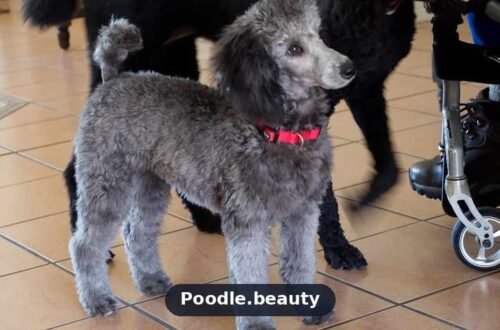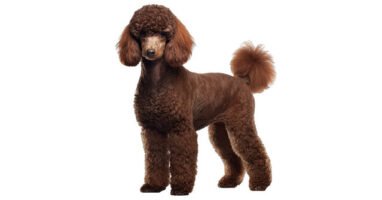
A phantom poodle looks like someone painted a second dog’s markings onto a poodle. The base coat is one solid color, and sitting on top of it, in very specific places, are lighter points: eyebrows, muzzle, chest, legs. Think Doberman markings, delivered in curls.
The phantom is not a breed, a mix, or a fault. It is a purebred poodle carrying the tan point pattern, and once you learn the placement map you will start spotting phantoms everywhere. This guide walks through that map, the colors the points come in, and how to tell a true phantom from its closest lookalike, the sable.
The Phantom Marking Map
Phantom markings are not random. They appear in the same positions on every correctly marked dog, which is exactly what separates phantom from patchy patterns like parti.
- Above the eyes: a distinct dot or patch over each eye, the famous eyebrows.
- On the face: lighter color along the sides of the muzzle and cheeks, sometimes under the jaw.
- On the chest: a clear patch between the front legs, often shaped like a bow tie or shield.
- On the legs: lighter color down the lower legs and over the feet.
- Under the tail: a patch at the rear, sometimes spreading slightly down the inner thighs.
Edges matter as much as placement. On a well marked phantom the border between base and point color is sharp, so you could trace it with a finger. Blurry, speckled, or wandering markings usually mean a different pattern is at work.
Which Colors Make the Points
The base is usually a darker solid: black is most common, followed by chocolate brown and silver. Red and apricot bases exist too, though the contrast can be subtler on them.
The points themselves come in tan, cream, apricot, or red, and occasionally silver on a black base. Breeders aim for contrast you can read across a park, so a black dog with rich tan points is the combination most people picture.
Intensity varies from dog to dog. Some phantoms carry pale cream points that glow against the black, while others wear deeper red points that show best in sunlight.
Silver phantoms sit at the soft end of the scale, since the base color has already lightened. All of these are correct; the depth of the lighter color is set by separate intensity genes.
Born With It: The Genetics
Phantom comes from the tan point pattern at the agouti locus, the same genetic recipe behind Doberman and Rottweiler markings. It is recessive, so a puppy needs the pattern gene from both parents to show it.
That single fact explains phantom rarity. Most solid poodles do not carry tan point at all, so breeders who want phantoms must pair known carriers, often confirmed by DNA testing, and build their lines deliberately.
Here is the part buyers love: phantom markings are present from birth and stay for life. The points do not fade in, wash out, or migrate as the dog matures. A phantom puppy’s map is the adult dog’s map, which makes choosing a puppy far less of a gamble than colors that clear with age.
Phantom or Sable? Telling Them Apart
Sable is the pattern most often confused with phantom, and the difference is in how the color sits on each hair. A sable poodle has individual hairs that are darker at the tip and lighter at the root, producing a shaded, smoky overlay that changes as the coat grows and is clipped.
A phantom’s two colors live in separate hairs in separate places. The points are fixed, symmetrical, and the same at any coat length. If the “markings” seem to drift, darken, or disappear after a haircut, you are looking at sable, not phantom.
For the other patterns buyers mix up, a parti poodle carries big white based patches in random spots, and a brindle poodle shows striping through a single base color. Phantom is neither patches nor stripes. It is points, in the same places, every time.
Registration and Showing
Phantoms are purebred, registerable poodles. The AKC accepts them for registration and welcomes them in performance sports like agility, obedience, and rally.
AKC conformation is the exception. The AKC breed standard calls for solid colors in the show ring, so a phantom cannot compete there, whatever its quality. The United Kennel Club recognizes multi colored poodles and does allow them in conformation, which is where most shown phantoms end up.
If showing matters to you, decide which registry’s ring you care about before you choose a breeder. If it does not, none of this affects the dog asleep on your feet.
Grooming to Keep the Points Crisp
Grooming a phantom is grooming a poodle: brush several times a week to keep the dense curl from matting, bathe as needed, and book a full clip every four to six weeks. Ears, nails, and teeth need the same routine attention as any poodle’s.
One choice does affect how the pattern reads. Shorter clips keep the points sharp, because the contrast sits close to the skin where the color boundary actually is. A long, fluffy coat softens and blurs the edges, and a phantom in full coat can look almost solid at a distance.
Many owners settle on a tidy sporting clip for everyday life and save longer styles for winter. Whatever you choose, tell the groomer where the points are so an overenthusiastic trim does not shave through a marking you love.
Health: The Pattern Is Not a Risk Factor
No health condition is linked to the phantom pattern itself. A phantom’s risks are the breed’s general predispositions, the same list a solid poodle owner should know.
That list includes hip dysplasia, progressive retinal atrophy and other inherited eye disorders, Addison’s disease, epilepsy, and bloat in Standards. These are tendencies in the breed, not certainties for any individual dog, and health tested parents lower the odds considerably.
PetMD keeps vet reviewed explainers on all of these if you want to read up. Then do the unglamorous things that actually move the needle: annual vet visits, a lean weight, and dental care.
When you talk to breeders, ask which of these conditions they screen for, and expect paperwork rather than reassurance. Eye certification and hip scoring are routine in serious programs, and DNA panels cover several inherited conditions at once. A breeder who health tests their solids but not their phantoms is telling you the pattern matters more to them than the dogs do.
Finding a Phantom Puppy
Expect to search and then wait. Because both parents must carry the gene, phantom litters come from breeders who plan for them, and good ones keep waiting lists. Instant availability, all year round, is the warning sign, not the convenience it looks like.
Phantom puppies often cost more than solid puppies from comparable breeders, thanks to the narrower gene pool and steady demand. Price should still track health testing and raising standards, not pattern alone.
Ask for both parents’ health screening, meet the mother, and use the checklist in our guide to buying a poodle puppy. If the markings are what drew you in, you may also enjoy our roundup of the rarest poodle colors.
- DNA or pedigree evidence that both parents carry tan point, not just a verbal promise.
- Health screening for both parents, shared before you pay any deposit.
- Puppies raised in the home and handled daily, with the mother on site to meet.
- A waiting list and a contract, both signs of a breeder planning litters carefully.
Frequently Asked Questions
Are phantom poodles rare?
Uncommon, not vanishing. Both parents must carry the tan point gene, so phantoms only come from deliberate pairings. You will likely join a waiting list, but you will not search for years the way you might for the genuinely rare colors.
Do phantom markings fade as the dog gets older?
No. The points are present from birth and remain in place for life. Coat length and clipping can soften how strong the contrast looks, but the pattern itself does not fade the way clearing colors like silver do.
Are phantom poodles purebred?
Yes. Phantom is a coat pattern within the breed, not a mix or a separate breed. Phantom puppies from registered parents are registerable poodles, eligible for performance events even though AKC conformation requires solid colors.
Does the phantom pattern affect temperament?
No. There is no evidence linking coat pattern to personality in poodles. A phantom’s temperament comes from its breeding, socialization, and training, exactly like a solid colored dog’s.
What is the difference between phantom and sable?
A phantom has two solid colors in fixed point positions. A sable has hairs that are dark at the tip and lighter at the root, creating a shifting shaded effect that changes with coat length. Fixed and symmetrical means phantom; smoky and changeable means sable.
Are phantom poodles more expensive?
Usually, yes. The genetics are restrictive and demand is high, so prices sit above solid colors from similar breeders. Pay for health testing and good raising first; the markings are the bonus.