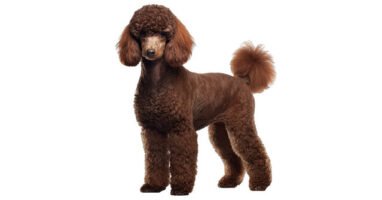
Let us be honest right at the start: an Aussiedoodle is not a relaxed dog with a cute coat. Cross an Australian Shepherd with a Poodle and you get two working brains stacked in one body, and that brain expects employment every single day.
Owners who do their homework tend to love this mix fiercely. Owners who bought one for the teddy bear photos and expected a couch companion are the ones filling rescue pages a year later, so this guide leads with the hard parts on purpose.
What You Are Actually Getting
The Australian Shepherd is not really Australian, and it is barely a casual pet either. It was built on American ranches to move stubborn cattle all day, read its handler, and make fast decisions on its own.
The Poodle side brings its own work ethic. Poodles were retrievers long before they were fashion statements, and the Standard in particular is an athletic, problem-solving dog that gets bored in an empty routine.
Blend the two and you get a dog that watches everything, learns patterns in days, and invents its own jobs when you fail to provide one. That invented job is rarely one you will enjoy.
Sizes, and the Merle Question Nobody Should Skip
Aussiedoodles come in three rough size bands, set by which Poodle parent was used. Toy crosses usually land between 10 and 18 pounds, Miniature crosses between 18 and 35 pounds, and Standard crosses commonly run 45 to 70 pounds.
Size changes the packaging, not the personality. A 15 pound Mini Aussiedoodle still has the full herding operating system, just in a body that fits under an airline seat.
Then there is merle, the swirled silver, black, and copper pattern everyone asks for. Merle comes from the Aussie side, and one copy of the gene gives the look people want.
Two copies is a genuine disaster, and this needs saying plainly: never buy from anyone who breeds two merle dogs together. Double merle puppies face a high risk of deafness, blindness, or both, and responsible breeders test and plan pairings to avoid it entirely. If a seller cannot explain how they avoid double merles, walk away.
Temperament: Devoted, Intense, and Nippy by Default
The good side is real. Aussiedoodles bond hard, often picking their people and shadowing them from room to room. Owners consistently describe a dog that seems to read moods and shows up exactly when someone is having a bad day.
The herding side is equally real. Many Aussiedoodles, especially youngsters, try to organise moving children, joggers, and other dogs by circling and nipping at heels. It is not aggression, it is an inherited work behaviour, but unsupervised it frightens kids and annoys everyone.
That heel nipping can be redirected with training, and it should be addressed from the first week, not excused as a phase. Families with toddlers who cannot yet be taught to stand still and call an adult are usually happier waiting a few years.
Sensitivity is the trait most buyers miss. This mix notices raised voices, tension, and changes in routine, and anxious handling makes an anxious dog. Calm, consistent households get the best version of an Aussiedoodle.
Energy: The Real Daily Numbers
Plan on 1.5 to 2 hours of combined activity a day for a healthy adult, and understand that physical exercise is only half of it. A tired Aussiedoodle body with a fresh brain still redecorates your house.
Mental work is the cheap shortcut nobody uses enough. Fifteen minutes of training games, sniffing work, or a puzzle feeder wears this mix out faster than an extra half hour of walking.
A realistic working day for an adult Standard looks something like this:
- Morning: 40 to 50 minutes of walking with sniff breaks, plus 10 minutes of training reps worked into the walk.
- Midday: a puzzle feeder or sniff game in the garden, 10 to 15 minutes, and a short toilet and play break.
- Evening: 30 to 40 minutes of fetch, flirt pole, or a training session, then a chew to settle.
Notice that none of this is exotic. What matters is that it happens every day, including the rainy Tuesdays, for the next 12 to 15 years.
If your schedule regularly delivers ten hour absences and an exhausted evening on the sofa, this mix will not quietly adapt. It will escalate, and the escalation usually involves barking, digging, or chewing through something expensive. Our guide to how much exercise a Poodle actually needs shows the parent breed baseline this mix builds on.
Coat and Grooming: Budget the Hours
Aussiedoodle coats usually land somewhere between wavy and tightly curled, and almost all of them are high maintenance. Expect brushing sessions several times a week to keep the coat from matting down to the skin, plus professional grooms every 6 to 8 weeks for most pet clips.
Now the part the adverts skip: no breeder can promise a non-shedding Aussiedoodle. First generation crosses in particular may shed moderately, because the Aussie parent has a double coat that definitely sheds. An F1 Aussiedoodle is a first cross: one Australian Shepherd parent and one Poodle parent, roughly 50 percent Poodle. An F1b is an F1 Aussiedoodle bred back to a Poodle, which makes the puppies about 75 percent Poodle, so the coat is usually more Poodle-like and sheds less than an F1, though no generation can promise a non-shedding dog. Anyone guaranteeing a shed-free coat is selling, not informing.
And no dog is truly hypoallergenic, this mix included. Some allergy sufferers react less to Poodle-type coats, but meeting adult dogs of the same cross before committing is the only honest test.
Health: What Comes Down Each Side
Aussiedoodles are generally sturdy dogs, but they inherit risks from both parents, and a good breeder tests for them openly. Our overview of common Poodle health problems covers the Poodle side of the family tree in more depth.
Hip dysplasia sits at the top of the list, a risk from both breeds. Ask to see hip scores or PennHIP results for both parents, not a vet’s verbal assurance that they move fine.
Eye conditions matter here too. Aussiedoodles can inherit progressive retinal atrophy from the Poodle side and collie eye anomaly from the Aussie side, a developmental eye defect that ranges from mild changes to serious vision loss. Both have DNA tests, and both parents should have them, alongside a current hands-on eye exam.
Epilepsy also appears in Australian Shepherd lines and can show up in the cross. There is no DNA test for it yet, which makes honest breeder records about relatives even more valuable.
The MDR1 Mutation, Explained Simply
Australian Shepherds commonly carry a mutation in the MDR1 gene, also called ABCB1, and an Aussiedoodle can inherit it. The gene normally helps produce a protein that pumps certain drugs out of the brain. When the mutation is present, that pump works poorly, so some otherwise routine medications can build up in the brain and cause serious, sometimes life threatening reactions. The drugs to discuss with your vet include ivermectin and related antiparasitics, loperamide, certain sedatives such as acepromazine, and chemotherapy drugs. WSU lists these among its problem medications for dogs with the MDR1 mutation, so check with your vet before any of them is given.
This is not a disease and it does not make a dog sick in daily life. It only matters when specific drugs are given, which is why a one-time DNA test is so valuable. Washington State University’s Program in Individualized Medicine, the team that identified the mutation, maintains the testing and drug information vets rely on.
The practical steps are simple: test your dog, put the result in writing in the vet file, and mention it before any surgery, sedation, or new prescription. Never skip normal parasite prevention out of fear, though. Your vet can choose products and plans that suit your dog’s MDR1 status safely.
Training: Give the Brain a Job Before It Finds One
This is where the mix shines, if you show up. Aussiedoodles typically learn new cues in a handful of repetitions and connect cause and effect faster than many owners expect.
Channel the herding instinct instead of fighting it. Fetch with rules, tug with a clear start and stop, treibball (herding a big ball into a goal), and scatter feeding in grass all scratch the same itch legally.
Formal outlets suit this mix unusually well. Agility, flyball, obedience, and trick titles give the dog a syllabus and the owner a community, and owners consistently report calmer house behaviour in weeks they train.
Start socialisation early and keep it boring. Calm exposure to traffic, visitors, livestock smells, and children playing at a distance builds the steady adult everyone wants. Flooding a sensitive young Aussiedoodle with chaos does the opposite.
What an Aussiedoodle Costs
Prices vary widely by region, size, and breeder quality, but most buyers in the US currently pay somewhere between $1,500 and $4,500 for a puppy. Merle puppies and Miniature sizes often sit at the top of that range, driven by demand rather than quality.
Running costs are where the real money goes. Professional grooming every 6 to 8 weeks typically runs $70 to $120 per visit for a Standard, and training classes, activity gear, and food for an active medium to large dog add up quickly across a 12 to 15 year lifespan.
Speaking of lifespan, most Aussiedoodles live around 11 to 15 years, with smaller dogs tending toward the longer end. Our breakdown of how long Poodle mixes live explains why size and parent health shift that range.
Who Should Not Get an Aussiedoodle
First-time owners with quiet, low-activity lifestyles are the classic mismatch, and there is no shame in that admission. The honest alternatives in our roundup of Poodle mixes for first-time owners exist precisely because this cross asks so much.
Skip this mix if you want a dog that is content with two short walks, if barking at passers-by would cause real problems with neighbours, or if weekly grooming sounds like a chore you will quietly stop doing. Also skip it if you cannot supervise young children around a herding breed yet.
On the other hand, runners, hikers, dog-sport dabblers, and work-from-home owners who want a genuine partner tend to thrive with one. The AKC’s Australian Shepherd profile and its Standard Poodle profile make useful reading before you decide, because an Aussiedoodle is those two dogs negotiating daily.
Frequently Asked Questions
Are Aussiedoodles good family dogs?
They can be excellent family dogs in active homes with older children who understand boundaries. The herding instinct to nip at heels makes them a harder fit for toddlers, and supervision plus early training are not optional extras.
Do Aussiedoodles shed?
Some shed lightly and some shed moderately, especially first generation crosses with more Aussie coat. Nobody can guarantee a non-shedding puppy, and no dog is truly hypoallergenic, so allergy sufferers should spend time with adult Aussiedoodles first.
How big does an Aussiedoodle get?
Toy crosses usually finish at 10 to 18 pounds, Miniatures at 18 to 35 pounds, and Standards at 45 to 70 pounds. Parent size gives a rough estimate, but individual puppies in a litter can vary more than buyers expect.
Are Aussiedoodles easy to train?
They learn extremely fast, which cuts both ways. Good habits form quickly, and so do bad ones, so consistency matters more than intensity. Short, frequent sessions with rewards work far better than long drilling.
What is the MDR1 test and does my Aussiedoodle need it?
It is a simple DNA test that shows whether your dog inherited the mutation affecting how certain drugs are processed. Given how common it is in Australian Shepherd lines, testing once and sharing the result with your vet is cheap insurance.
How long do Aussiedoodles live?
Most live 11 to 15 years, with smaller dogs often reaching the upper end. Parent health testing, healthy weight, and regular vet care move the odds more than any supplement or premium food claim.