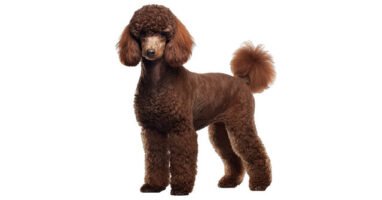
Ask ten people what a Moyen Poodle is and you will get ten slightly different answers. Here is the short one: a Moyen is simply the medium size of the same purebred Poodle, bigger than a Miniature, smaller than most Standards, and recognized as its own size variety in Europe.
That last part is where the confusion starts. Whether a Moyen counts as a separate size at all depends on which kennel club you ask, and that affects everything from paperwork to price. This guide sorts out what the size actually is, what these dogs are like to live with, and what to watch for when buying one.
What “Moyen” Actually Means
Moyen is French for “medium.” Under the FCI, the international kennel federation used across Europe, Poodles come in four sizes: Standard, Medium, Miniature, and Toy. The Medium is the Moyen, and it has been a distinct, pedigree-tracked variety there for generations.
The American Kennel Club recognizes only three sizes. In the AKC system, any Poodle over 15 inches at the shoulder is a Standard, full stop. So the same dog that is a Medium in Paris is a small Standard in New York, at least on paper.
German breeders use the word Klein, meaning small, for the same in-between dogs. Moyen and Klein describe the same idea: a Poodle bred to land in the middle of the size range rather than at either end of it.
How Big Does a Moyen Get?
The FCI standard puts the Medium variety at 35 to 45 cm at the shoulder, which is roughly 14 to 18 inches. Weight varies with build, but most fall somewhere between 15 and 30 pounds.
American-bred dogs sold as Moyens often run a touch larger, sometimes up to 20 inches and 35 pounds. That is because many US Moyen lines are produced by breeding smaller Standards to larger Miniatures, and the puppies scatter a bit around the target.
Practically, expect a dog you can lift into the car without help, but that is still substantial enough for rough play, hiking, and keeping up on a run. Buy equipment for the dog in front of you: a medium crate, a medium harness, and toys sized for a mid-sized mouth.
Where the Medium Size Came From
The medium dog is not a recent invention. As the breed spread from its German working roots, European breeders kept Poodles in a range of sizes for different jobs, and the middle size held its place in French and German breeding long after the AKC settled on three classes.
European clubs preserved the four-size structure in their pedigrees, which is why properly documented Moyens usually trace back to European lines. The variety never disappeared. It just stayed less visible in countries whose registries folded it into the Standard class.
Rising demand in the US is a lifestyle story. Plenty of people want a Poodle with the Standard’s substance but find 60 pounds of dog more than their home, car, or knees want to manage. The Moyen sits exactly in that gap, which is why breeders have started supplying it.
Temperament: The Same Dog in a Middle-Sized Body
A Moyen has the standard Poodle temperament because it is a standard Poodle temperament, just in a smaller frame. Expect the breed’s usual package: quick to learn, deeply people-focused, alert without being frantic, and bored within about ten minutes of having nothing to do.
Most are friendly once introduced but reserved with strangers at first, and they tend to appoint themselves household announcer when someone knocks. Owners consistently report strong bonding, sometimes to the point of shadowing their person from room to room.
That devotion cuts both ways. Moyens left alone for long stretches can develop separation anxiety, so they suit homes where someone is around for a good part of the day. If your household is empty from dawn to dark, be honest with yourself about whether any Poodle size is the right choice right now.
Exercise and Training Needs
Plan on roughly an hour of real activity a day. Brisk walks, a game of fetch, a swim, or a hike all count, and most Moyens are athletic enough to jog short distances with you once fully grown.
Physical exercise alone rarely settles a Poodle. Add ten to fifteen minutes of training games, a puzzle feeder, or a scent game most days, and you will notice the difference in the evenings.
Training itself is usually the easy part. These dogs pick up cues fast and read their owners well, so keep sessions short, upbeat, and reward-based. Harsh corrections tend to produce a worried dog rather than a better-behaved one, and early socialization matters as much as obedience: new people, new sounds, new surfaces, all in the first months.
The Coat: Same Commitment, Slightly Less of It
The Moyen coat is the classic Poodle coat: dense, curly, and low-shedding, which is why the breed appeals to allergy-sensitive households. Be precise about that, though. No dog is truly hypoallergenic, and the low shedding helps only because loose hair and dander stay trapped in the curls instead of spreading around the house.
Trapped hair is also the problem. Without brushing, those curls felt into mats close to the skin, so plan on a thorough brush-out at least three times a week and a professional clip every six to eight weeks.
The total workload is a bit lighter than a big Standard simply because there is less dog to brush, but the routine is identical. Ears need regular checks too, since those hanging ear flaps trap moisture. If you are weighing sizes partly on grooming effort, the breakdown in Toy vs Miniature vs Standard shows how the sizes compare.
Health and Lifespan
Moyens are generally robust dogs, and a lifespan of 12 to 15 years is a fair expectation for a well-bred, well-kept one. You can see how that compares across the breed in our guide to Poodle lifespan.
They do share the breed’s known predispositions. Hip dysplasia shows up in this size, progressive retinal atrophy can cause gradual vision loss, and sebaceous adenitis, a skin condition affecting the oil glands, appears in Standard-derived lines. Epilepsy is also reported in the breed.
None of these are certainties, and this is exactly why health testing matters more than marketing. A responsible Moyen breeder can show you hip evaluations and eye clearances for both parents, ideally through OFA or a similar registry, and DNA results where relevant tests exist.
The Sourcing Problem: Why Moyen Puppies Need Extra Scrutiny
Here is the part most guides skip. Because the AKC has no Moyen class, the word carries no official meaning in the US, and anyone can put it on a litter listing.
Some sellers use it for genuinely well-planned medium-sized litters. Others use it as a premium label on ordinary small Standards, or on Miniature and Standard crosses with no health testing behind them.
Protect yourself with a short checklist before paying any deposit:
- Ask for the height and weight of both parents, not just the label on the advert.
- Ask to see hip and eye test results for both parents, in writing.
- Ask whether the puppies come with registration papers, and under which registry.
- Ask what happens if a puppy grows well past the promised size range.
- Walk away from any breeder who guarantees an exact adult size. Genetics does not work that way.
Breeders listing through the Poodle Club of America breeder referral are a reasonable starting point, and the FCI standard itself, published at fci.be, is worth reading so you know what a true European Medium actually measures.
Is a Moyen Right for You?
A Moyen fits best if you want the full Poodle personality and athleticism but a dog in the 20 to 35 pound range suits your space, travel style, and strength better than a large Standard. Apartment living works fine provided the exercise and mental work happen daily.
It is a poor fit if you want a low-maintenance coat, a dog that is content alone all day, or a bargain puppy. Well-bred Moyens often cost as much as or more than Standards because supply is thin, and our breakdown of buying a Poodle puppy explains what separates a careful breeder from a slick listing.
Common mistake to avoid: choosing the Moyen purely as a compromise without meeting the parents or seeing adult dogs from the same lines. Puppies are all cute. The adult dog, its size, coat, and energy, is what you will live with for the next decade and a half.
Frequently Asked Questions
Is a Moyen Poodle a purebred or a mix?
It is a purebred Poodle. Moyen describes a size, not a crossbreed. In Europe the Medium variety is one of the breed’s four recognized sizes with its own pedigrees.
Why does the AKC not recognize the Moyen?
The AKC has only ever registered three Poodle sizes, and any dog over 15 inches tall falls into the Standard class. A Moyen in the US is therefore registered, shown, and recorded as a Standard regardless of what the breeder calls it.
What is the difference between a Moyen and a Klein Poodle?
Nothing of substance. Moyen is the French word and Klein the German word for the same medium size. If a seller claims they are different varieties, ask more questions.
How much does a Moyen puppy cost?
Usually at or above the price of a well-bred Standard puppy, because fewer breeders produce them and demand is high. Prices vary widely by region and breeder, and a suspiciously cheap “Moyen” listing is a warning sign, not a bargain.
Are Moyens good apartment dogs?
Yes, with conditions. Their size suits smaller homes, but they still need about an hour of exercise and some mental work daily. A bored Moyen in a flat will invent its own entertainment, and you may not like the results.
Do Moyen Poodles shed?
Very little, because the curly coat holds loose hair instead of dropping it. That is not the same as no maintenance: the trapped hair mats, so regular brushing and clipping are part of the deal.




3 Comments on “Moyen Poodle: Complete Breed Guide for New Owners”