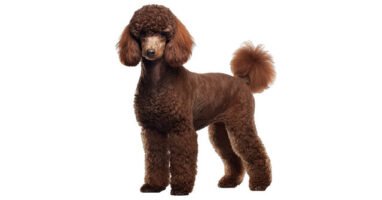
A Toy Poodle puppy develops on a schedule measured in weeks, not months. The same fortnight that barely registers on a big breed can carry a Toy from wobbly newborn to eyes open, walking, weaning, and ready for a new home.
That speed cuts both ways. Milestones arrive quickly, but so can trouble, because a puppy who weighs less than a bag of sugar has almost no reserves. This guide follows Toy development stage by stage, explains the one real danger of the early weeks, and gives you honest ways to predict the adult dog waiting at the end of it.
The Finished Article: Adult Toy Size
Under the AKC breed standard, a Toy Poodle stands up to 10 inches at the shoulder. The standard sets no weight, but adults in good condition typically weigh 4 to 6 pounds on a fine boned, elegant frame.
Individual dogs step outside those figures. A healthy Toy can finish at 7 pounds of solid condition, and an undersized one can be perfectly sound at 3.5. The standard describes the breed ideal, not a pass or fail line for pets. Our Toy Poodle breed guide covers the adult dog’s temperament and care in depth.
Weeks One to Two: The Newborn Stage
Toy puppies are born weighing roughly 3 to 5 ounces. They cannot see, cannot hear properly, and cannot regulate their own body temperature. Everything in this stage is about warmth, nursing, and sleep.
Healthy newborns gain steadily, often close to doubling birth weight within the first ten days to two weeks. A puppy who is not gaining daily in this window needs veterinary attention quickly. At this size there is no spare day to wait and see.
Weeks Three to Four: Senses Switch On
Eyes open at around two to three weeks, ears follow, and the puppies begin wobbling around the whelping box on unsteady legs. First teeth start pushing through toward the end of this stage.
Weight by four weeks commonly sits somewhere around 12 to 20 ounces, though litter size and the dam’s milk supply move individuals around. Puppies also start showing the first flickers of personality, which is more entertaining than useful, but breeders watch it closely anyway.
Weeks Five to Six: Weaning Begins
This is when solid food enters the picture, usually as a soft, soaked puppy food offered alongside nursing. Puppies play fight, explore, and start learning the basics of being a dog from their mother and littermates.
Growth continues at full pace, with many puppies passing the one pound mark during this stage. Handling by people should be gentle and daily, building the confidence Toys are known for without overwhelming tiny puppies.
Weeks Seven to Eight: Ready to Leave
By eight weeks, the usual rehoming point, most Toy puppies weigh between 1.5 and 3 pounds. They are eating solid food, playing hard, and sleeping almost as hard.
Leaving earlier than eight weeks is a red flag in a breeder, whatever the reason given. Those final weeks with littermates teach bite inhibition and social skills that humans are poor at replacing. Our guide to buying a poodle puppy lists the other questions worth asking before you commit.
Months Three to Six: The Fast Finish
Toys do the bulk of their remaining growing early. A three month old commonly weighs 2.5 to 4 pounds, and by six months most have reached 3.5 to 5.5 pounds and close to their adult height.
The proportions look odd for a while. Legs seem too long, the body too narrow, and the whole puppy can look like a rough sketch of the finished dog. It evens out. Feed measured meals of a small breed puppy food, keep up the vet’s vaccine and deworming schedule, and let the curve do its work.
Months Six to Twelve: Filling Out
Height is essentially finished for most Toys by eight months, occasionally earlier. What changes after that is condition: the chest deepens a little, muscle replaces puppy pudge, and weight settles into the adult 4 to 6 pound range.
A few Toys keep maturing quietly toward eighteen months, particularly smaller framed ones. If your dog looks finished at ten months, it very likely is.
The Real Danger: Low Blood Sugar in Tiny Puppies
Hypoglycemia, a drop in blood sugar, is the emergency Toy owners genuinely need to know about. Very young and very small puppies burn energy fast and store very little, so a missed meal, a stressful day, chilling, or a minor illness can tip blood sugar down faster than it would in a larger puppy.
Warning signs include unusual sleepiness or weakness, wobbly or drunken movement, trembling, a blank or glazed look, and loss of appetite. In serious cases a puppy can progress to seizures or collapse. A puppy showing these signs needs a veterinarian immediately, not home experiments.
Prevention is mostly routine. Feed young Toys little and often, typically four small meals a day at first, keep them warm, and do not let visitors play a small puppy to exhaustion. PetMD’s overview of hypoglycemia in dogs explains the condition and its causes in more detail.
Predicting Adult Size Honestly
Everyone wants a number. The honest answer is that you can get a decent estimate and nothing stronger, because growth is genetics plus everything that happens along the way.
Start With the Parents
The single best predictor is the adult weight of the sire and dam. Puppies usually finish somewhere near their parents, most often inside the span between them. A breeder who weighs their adults and tells you the figures plainly is giving you better data than any formula.
Use the Rules of Thumb as Rough Guides
Two common estimates circulate among breeders. Tripling or quadrupling the eight week weight gives a ballpark adult figure, and doubling the weight at four months does roughly the same job. Both are approximations with real spread, so treat the result as a range with a pound of slack either side.
The all varieties poodle growth and weight chart shows how those estimates line up against typical weights at each age.
The Paw Myth, Handled Straight
The old claim says a puppy with big paws grows into a big dog. In large breeds there is a grain of correlation, because everything about those puppies is scaled up. In Toys it is close to useless.
Toy puppies’ paws are not a reliable gauge of anything except being puppy paws, which look oversized on most young dogs during the leggy stage. Pups from the same litter with similar paws routinely finish a pound or more apart. If size certainty matters to you, buy on parent weights and breeder honesty, not on paw inspection.
Feeding a Toy Through Development
Small breed puppy food exists for a reason: higher energy density in a kibble small enough for a tiny jaw. Feed measured amounts on a schedule rather than leaving food down all day, so appetite changes, which are an early illness signal, stay visible.
Most Toys move to two or three meals a day by six months and onto adult food around nine to twelve months, once growth has clearly levelled. Because the margin for error is thin in a five pound dog, portion changes should be small and checked against body condition monthly.
Size Related Health Awareness
Small size carries its own risk profile. Toys as a variety have predispositions worth knowing about, including dental crowding, patellar luxation, and tracheal issues, none of which are certainties and all of which vets screen for at routine visits.
Our overview of poodle health problems by size sets out what each variety is prone to and what early signs look like. VCA Hospitals’ poodle profile is another solid reference for the breed’s health picture.
Frequently Asked Questions
How big do Toy Poodles get when fully grown?
Most stand up to 10 inches at the shoulder and weigh 4 to 6 pounds as adults. Build and lineage shift individuals slightly either side of that range. Condition matters more than the exact figure.
When do Toy Poodles stop growing?
Height is usually finished by six to eight months. Weight and muscle keep settling until about twelve months, and the smallest Toys occasionally mature until eighteen months.
How much should an eight week old Toy Poodle weigh?
Typically between 1.5 and 3 pounds. Puppies heading for the smaller end of the adult range sit near the bottom of that band. Steady daily gain matters more than the exact starting weight.
Can big paws tell me how large my Toy puppy will grow?
Not reliably. Paw size is a weak guide even in big breeds and tells you very little in Toys. The parents’ adult weights and the puppy’s own growth curve are far better predictors.
Why do Toy puppies need so many meals a day?
Tiny puppies store very little energy and burn it quickly, so long gaps between meals risk a blood sugar drop. Four small meals a day in the early months keeps levels steady. The number can reduce as the puppy grows and stabilises.
My Toy puppy seems smaller than the ranges here. What should I do?
Check the trend first: a small puppy who gains steadily, eats well, and is bright and active is usually just small. If weight stalls, appetite drops, or energy dips, book a vet visit promptly, because tiny puppies have little margin for delay.




2 Comments on “Toy Poodle Growth Guide: Size, Weight & Development”